
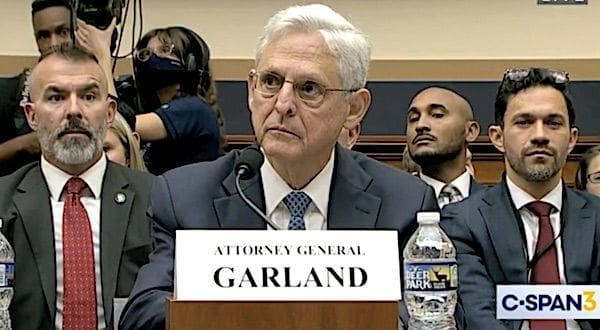
Biden Justice Department officials raised serious concerns about the DOJ treating concerned parents like domestic terrorists before Attorney General Merrick Garland released his memo directing investigations into school board protests in 2021, a new report from the Trump administration’s Weaponization Working Group reveals.
DOJ attorneys repeatedly questioned the proposal internally. One official called the effort “ridiculous.” Another complained that the department was deploying “an awful lot of federal manpower for what is currently non-federal conduct,” and that “almost all” of the conduct cited by school boards involved speech protected by the First Amendment.
The issue traces back to September 2021, when the National School Boards Association sent a letter to President Joe Biden urging federal action against alleged threats against school board members. The letter suggested the government could treat some conduct as “the equivalent of a form of domestic terrorism,” and cited disputes involving COVID-19 mandates, critical race theory, transgender orthodoxy, and other issues.
White House officials reportedly provided feedback on the letter before its release. Garland issued a memo directing the FBI and U.S. attorneys to coordinate responses to alleged threats just five days after the letter. The school boards association later apologized for the letter.
While critics have long argued that the Garland memo improperly targeted concerned parents, the new report offers an inside view of the Biden Justice Department’s opposition from within.
Internal emails show DOJ officials initially viewed many of the incidents cited in the NSBA letter as local matters rather than federal crimes and struggled to identify any clear federal law-enforcement role.
According to the report, White House officials first reached out to the DOJ for legal options on Sept. 22, 2021, one week before the NSBA letter’s publication on Sept. 29. The White House repeatedly pressured the DOJ, describing the issue as “fairly urgent,” according to the report.
Robyn Thiemann at the Office of the Deputy Attorney General noted that many other DOJ officials objected to the proposal and summed up her frustration: “This is ridiculous.”
Steven Jensen at the FBI’s Counterterrorism Division warned that “this is potentially dangerous ground.”
“I believe we need to stay focused on actions of individuals and the individual motivation,” he wrote. “Not all who oppose school board actions or legislative decisions are domestic terrorists.”
“I don’t think it’s possible to state how strongly I object to this,” wrote Kevin Driscoll, a deputy assistant attorney general at the DOJ’s Public Integrity Section. He warned that the move would “damage the reputation of the Public Integrity Section,” wryly adding that “if they do this, they might as well rename the damn thing the Anti-MAGA Task Force.”
Paige Fitzgerald at the Civil Rights Division wrote, “it seems that we are ramping up an awful lot of federal manpower for what is currently non-federal conduct.”
“Almost all of the language being used is protected by the First Amendment,” she noted. The only kind of lawbreaking in question seemed to be “disruption and obstruction of school board meetings,” which may involve local crimes but “nothing remotely federal.”
The Weaponization Working Group report notes that the FBI developed 25 “Guardian” assessments on parents seen as a threat to school boards. The FBI’s Counterterrorism Division handled six of the cases. None of the cases resulted in prosecution.
While the investigations did not produce prosecutions, the report quotes concerned parents who said the DOJ produced a chilling effect.
To correct such harms, the department announced that it will offer parents and other school board protesters who became the subject of an FBI investigation the opportunity to review the probes, and it will add a disclaimer to the relevant reports. The department will also review the files for constitutional rights violations, and issue formal apologies where appropriate.
The DOJ will direct $1.5 million to the National Association of School Resource Officers, to help inform school employees of the rights of parents.
The DOJ will also provide funding to train schoolteachers and staff about parents’ rights to direct the upbringing of their children, and their First Amendment rights.
[Editor’s note: This story originally was published by The Daily Signal.]

